


“Where do you think my next step is? What is the first thing, the first few things I should start, and then maybe what’s next?”
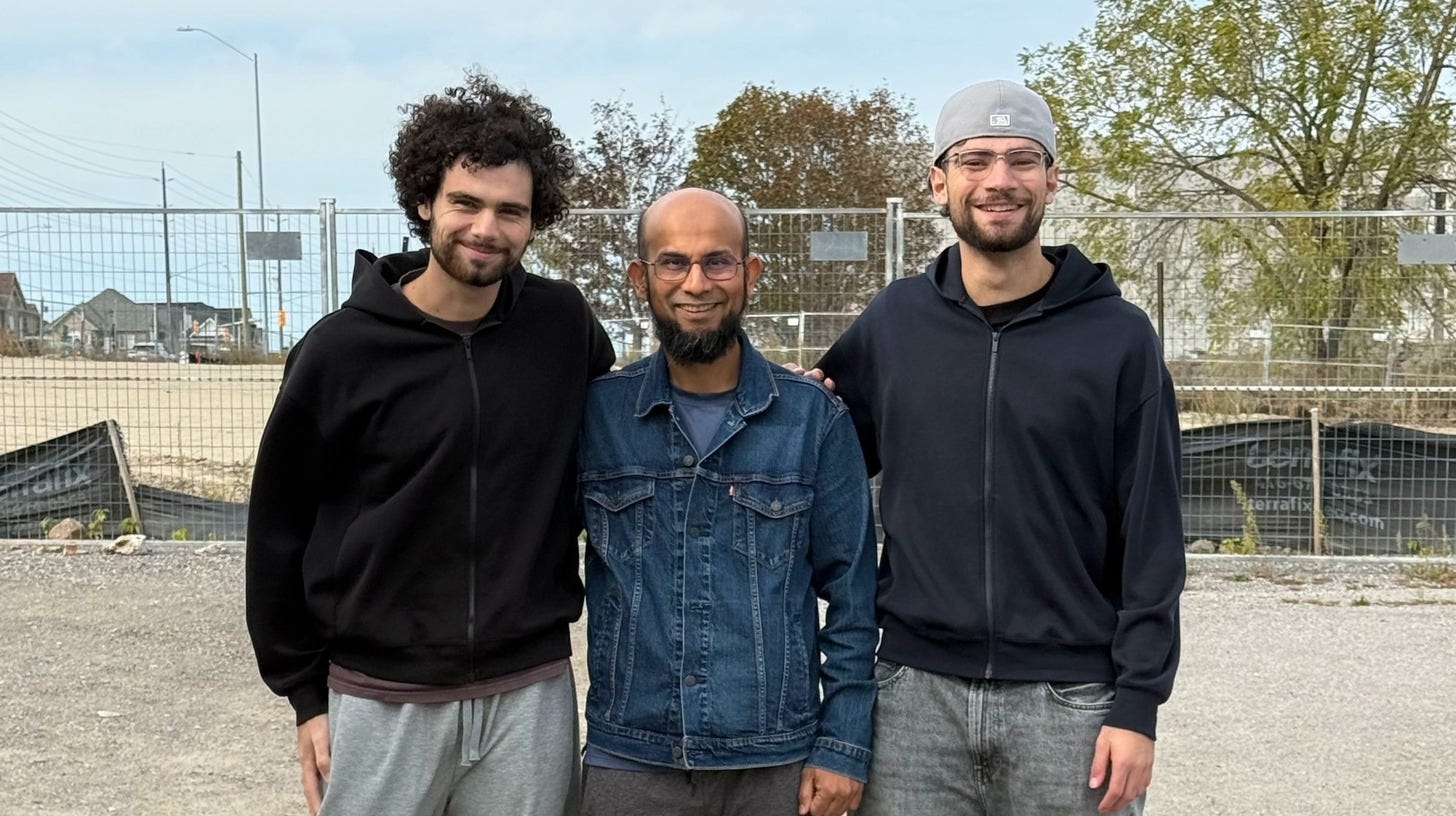
Ahmed asked me that about halfway through our session. He and his brother Muhammad are third-year students in the Bachelor of Artificial Intelligence program at Durham College. In October, the three of us sat down for about an hour to talk about their careers.
Before I give anyone advice, I want to know where they stand. So I started with questions. Which courses have you taken? What projects did you build? Which machine learning algorithms did you practice with?
The problem they brought
Next summer, both of them need an internship. In their program it is mandatory. If they don’t get a placement, they don’t graduate.
They had done the coursework: programming in several languages, databases, an introduction to machine learning, then a course on regression and another on classification. They had done exploratory data analysis. Muhammad had already built a resume and a portfolio with three projects aimed at the kind of job he wants.
But when I asked them to name the main machine learning algorithms, they could not. Ahmed told me he couldn’t remember the names off the top of his head.
Muhammad was honest about it. “As you can see, the background information is non-existent right now,” he said. “That’s exactly what would happen if we got an interview right now. Like we’d be lost.”
Ahmed put it another way. “We were aware that we were unaware.”
So I told them how I work with mentees. I will always be direct. I want my mentees to grow, so I will not sugarcoat. Here is where you stand, and here is what you need to fix. If I have to be nice all the time, I’m not really helping you.
“Just tell us,” Ahmed said. Here is what I suggested.
1. Know the main algorithms well enough to explain them without notes
If someone asks you to name the main machine learning algorithms, you need to answer off the top of your head. Linear regression. Logistic regression. Decision tree. Random forest. XGBoost. Support vector machine. Neural networks.
Then you need an intuition for how each one works. You don’t need to explain it at a very deep level. I don’t think anyone will ask you for that. But you need a mental model.
Take a decision tree. You build a tree that branches out. When you give it an input, which is a collection of features, it follows the branches until it reaches a decision.
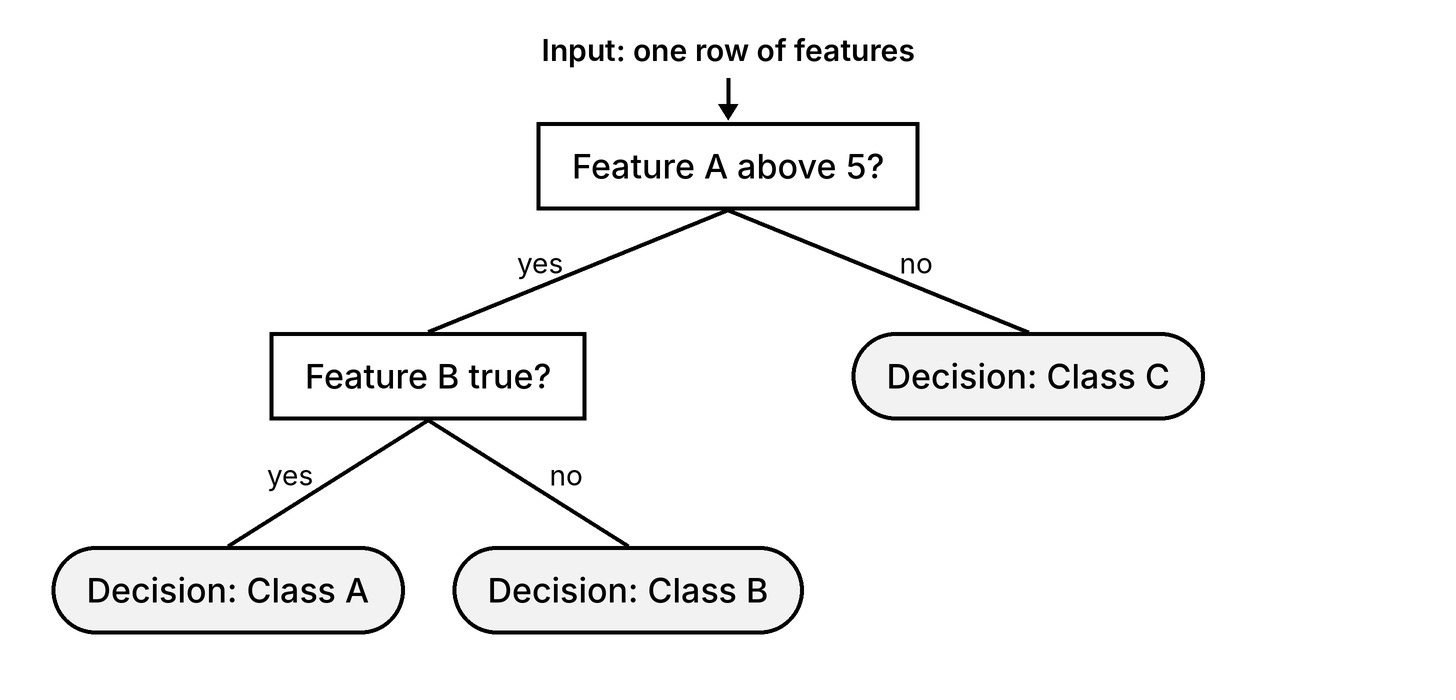
XGBoost is not a single tree. It is many trees, and their outputs are combined into the final prediction.
That is the level you are expected to know. After that come the lower-level details, such as the specific hyperparameters and how to tune them. You need those as well. But first, the algorithms and how they work.
Know the categories too. In supervised learning, you give the algorithm inputs with their outputs, and it learns the mapping, like a function. Show it a picture of an object and it tells you which predefined category the object belongs to. In unsupervised learning, you give no clue about the output. Hand the algorithm a collection of objects and it finds its own way to group them: by colour, by size, or by how people use them.
2. Learn two skills every AI role now needs: coding agents and production RAG
Next I asked them about large language models. Had they built anything with retrieval augmented generation? Had they used a coding agent to generate code?
Start with coding agents. Claude, Codex and others. Everyone is using them. You need to learn how to use them well.
Generating code is cheap now. Anyone can write a prompt and get thousands of lines of code in a few minutes. The hard part is planning the generation: what exactly do you want the agent to build? Many developers skip the plan. They give a prompt, generate the code, and move on, without enough verification.
Think of the agent as a worker, and yourself as the team lead. You supervise the whole process. You go in iterations until the code is high quality. Then it moves on to QA and integration testing. No matter what role you pick in AI or software engineering, this skill is fundamental.
The second skill is retrieval augmented generation, or RAG. Not the basic version. Anyone can build the basic one. Learn what it takes to move a RAG system to production. That means you can deploy it, your employer can start using it, and you know how to monitor and measure it.
3. Be able to explain your system from the inside
Muhammad pulled up his portfolio and described one project, Ask Local. He runs it from Visual Studio: he types a prompt, and the app opens as a website. It runs fully on your own machine. You upload your files, ask a chatbot questions, and it answers from those files.
I stopped him there.
Any system you build has two views. One is the external, user-facing view. How does a user use it? What problem does it solve? You ask a question, and the system gives a response.
The other is the internal view. How did you build it, step by step? Which models did you pick? What design decisions did you make?
In an interview, you’ll be expected to explain the internals. Muhammad said he had notes on all of it. You cannot look at notes. You need to describe at least the main parts yourself. And if the interviewer asks why you picked this LLM and not another one, you need to have thought through that choice: how you made the pieces work together, and what your thought process was. That is your engineering intuition.
Muhammad was honest again. “Right now I’m not ready,” he said. “I’m not at the point where I can explain anything. I know that. I have all the information I need to study in order to be able to do that.”
That is a good point. Many students are not even there. He has a good start.
4. Work backward from the internship you want
Then I came back to Ahmed’s question about his next step.
I don’t tell my mentees to do open-ended learning. There are so many model types, use cases and platforms, and new articles every day. If you soak up everything you see on LinkedIn, you will be lost.
So for any goal, I work backward. The idea comes from Amazon. Before Amazon builds a product, the team first designs what the finished product will look like. Then they ask what they need to do right now to get there.
Here is how I suggested Ahmed and Muhammad apply it.
Find a few job postings for the kind of internship you want next summer. You can find them today, even if you are not applying yet. Look especially at postings from big companies. Read what they ask for.
Then go to LinkedIn and find students who already got those internships. Look at ten or fifteen of them, maybe more. Not everyone got there because of a strong portfolio; connections and other reasons play a part. So look broadly, then shortlist the profiles that really stand out.
Now you have two sets of data points: what employers ask for, and what the students one step ahead of you did. Then make a plan for what it will take to reach their position.
I did not give Ahmed and Muhammad twenty things to do. With twenty things and no feedback, they would be lost. A small step at a time works better. In a few months, they will be in a much stronger position.
5. Build one project from your own problem
Resumes still matter. You need a good one to apply. But a resume alone is not enough anymore. You need a strong online presence: a LinkedIn profile with activity, and a GitHub that shows your work.
If your LinkedIn profile, your posts, and your GitHub look like everyone else’s, you’ll be treated like everyone else. If you want a different outcome from an employer, you need to be different.
“What does it mean to be different?” Ahmed asked.
Many students clone someone else’s project from GitHub, make a few minor tweaks, and call it a portfolio project.
I believe a strong portfolio project comes from solving your own problem, with your own data set and your own implementation. Anyone can clone a popular repo or ask an LLM for a project idea. But if the problem, the data and the implementation are yours, no one can copy you.
I told them how I built one of mine a few months ago. I wanted an AI-powered search application for my demos at work. So I looked for a broken search experience in the things I do every day.
I have listened to audiobooks for 15 years. I have 92 books in my collection. The only way my audiobook app lets me find a book is with a specific keyword from its title. I cannot say, show me the books on public speaking. It is an old style of keyword search, with no support for natural language queries.
So I decided to fix it. I pulled the metadata for all my audiobooks. Then I built a search on vector embeddings, a modern AI-based representation that lets you find content with natural language queries. The search became much better.
When I present the app at conference talks and webinars, I start with the broken search, show my own data, and compare the two searches side by side. Then I go under the hood: the components, the models I chose, and how I put them together. Others could copy my project. But I am not copying anyone else’s.
When the project is yours, you get excited about it. That excitement reaches the interviewer. They can tell the work is coming from you.
Compare that with what I often hear when I ask a student about their portfolio. They built a RAG in a university course and loaded some PDFs. Then I ask them to explain the pipeline, and they say they have to look at it. That tells the interviewer the student does not know what they built.
So instead of ten portfolio projects, pick one very solid one. Keep improving it, and write about each iteration. Systems are built in iterations. Showing yours shows your thinking, and shows the project getting closer to production readiness.
6. Post what resonated with you, in your own words
Before we wrapped up, I gave them homework.
Pick the few points from our discussion that really resonated with you: something you did not know, or something you knew but did not see as important. Then write a LinkedIn post about those points, and say what you are going to act on. I asked each of them to do it separately, without discussing it with each other.
Here is why. I have hired many interns over my 20 years at IBM. Say I get ten resumes and open each student’s LinkedIn profile. Nine have no posts in the last ten months, and maybe a cloned second-brain project on GitHub. That does not impress me.
The tenth student is being mentored by someone from a big company and posts every week or so. I had a session with my mentor. Here is what I learned. Here is what I’m going to do. A week later: here is my progress. That gives me confidence the student has a growth mindset. That is the one who stands out.
Posting also helps you remember what you learned, and it makes a social commitment.
Keep it conversational. Imagine your dad asks you tonight what you learned today, and write what you would tell him. You can use an LLM for minor edits, but the words should be yours.
“I like that a lot,” Ahmed said. “It’s creating that documentation that we need for the recruiters to see.”
Over the next few months, I’d like them to go further, with blog posts and short videos about their projects.
What they chose to do first
Both of them agreed on the next step: find the internship postings, study the profiles of students who got those internships, and write the LinkedIn post.
Ahmed added something I did not expect. “When you were asking me questions, I found it really helpful,” he said. “It kind of gauged my knowledge. I know those things, but because you called me out on it, it opened my eyes to, okay, maybe I’m a little more arrogant than I thought.” He wants to go back, learn the algorithms properly, and have me ask him the same questions next time.
I also offered them mock interviews. Take me through your portfolio project, and I’ll ask the questions an interviewer would ask about your engineering decisions.
We don’t need to meet every week. Mentorship is a two-way relationship. We meet when they have made progress and have specific questions. Between two conversations, take a step. Then come back, and we look at it together.
Thank you, Ahmed and Muhammad, for your honesty, and for letting me share our conversation.
If you hire interns, what makes a student’s profile stand out to you? And if you are a student, which of these would you start with? Tell me in the comments.