


A calculator does not need machine learning. Two plus two is always four.
Machine learning is only needed when we do not know the exact formula. That was the main idea in my mentoring session yesterday with Peddinti Bharadwaj.
The session
Peddinti is a QA engineer who is beginning with ML foundations. Since our previous call a week earlier, he had reviewed the concepts behind supervised machine learning: models, estimators, and how inputs map to an output.
I had pointed him to An Introduction to Statistical Learning, by Gareth James, Daniela Witten, Trevor Hastie, and Robert Tibshirani. The authors make the book free to download at statlearning.com. Peddinti read from it and asked an AI chat to add real world scenarios.
I recorded our session and cut the key ideas into a 7-minute video.
Below are the same ideas in writing, in the order I explained them to Peddinti.
1. Observations: inputs and an output
Supervised machine learning starts with observations. Each observation is a set of inputs and an output.
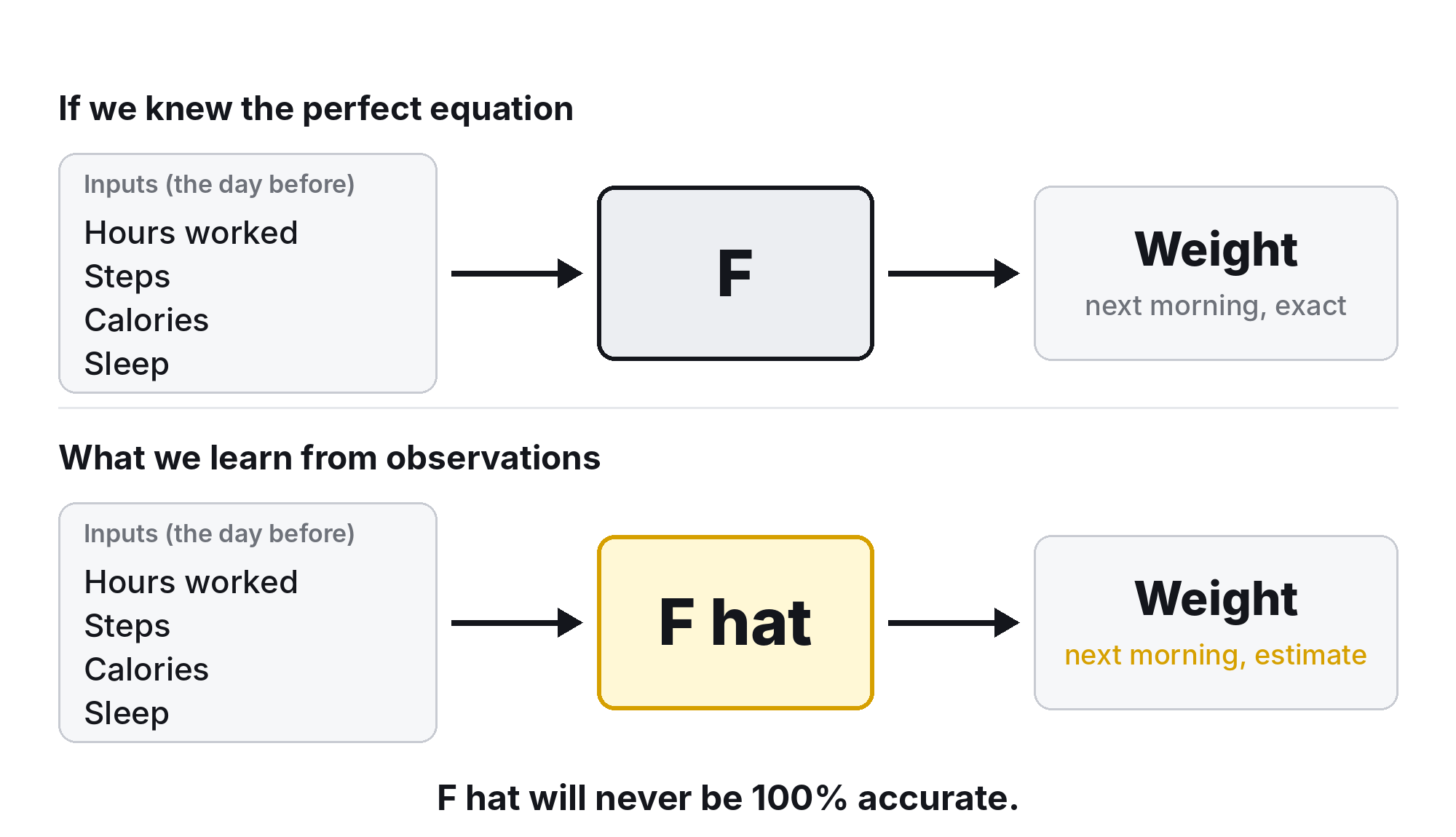
I used my own example. Each day I record my activities: hours worked, steps, calories, and sleep. The next morning, I measure my weight. My activities are the inputs. My weight is the output.
2. The perfect equation, F
Now assume there is a perfect equation, F, that maps all the inputs to the output with 100% accuracy.
If we had complete knowledge of all the inputs, we would not need a learning algorithm. We could write a program, like a calculator. Two plus two, always four.
3. F hat, the estimator
In the real world, we do not know F. So from observations, we model the relationship between input and output. This model is F hat, an estimator, closer to the real F.
F hat will never be 100% accurate. If we could get 100% accuracy, “that’s not a learning problem anymore.”
Every learning task has some form of this estimation, including LLMs.
4. “How do we estimate?”
This was Peddinti’s question. He added, “This is where I’m getting a lot of confusion.”
The first step is data collection. Without data, we cannot learn the relationship between input and output.
With the data in hand, we try different learning algorithms. The type of output tells you the type of problem. Predicting a number is a regression problem. Predicting a label, such as whether an email is fraud, is a classification problem. Experiment to see which algorithm does a better job on your data set. An AI coding agent can set up experiments that compare the algorithms.
5. A continuous learning loop
Once you pick a model, keep checking it. As new observations become available, check whether last week’s model is still doing a good job or its accuracy is dropping. If accuracy drops, update the model.
Peddinti’s next step
These ideas stick better when you apply them to a problem you care about. So I asked Peddinti to find a use case from his personal or work life that he can write about publicly. Nothing sensitive or confidential.
The output should be something he can measure. Energy level, for example, would be a guess.
He had an idea during our call: the petrol consumption of his bike against the traffic at each junction on his way to the office. I told him to brainstorm with an AI chat and ask it to interview him about whether he has the data.
Why your own data
I do the same with my own data. I log my food, calories, macro breakdown, protein, water, and step count, and I measure my weight every morning. I have this data from the last few years, so I can build these models on it.
That is what I want for Peddinti, and for you if you are starting with machine learning: your own data, your own problem, your own learning task.