


About nine years ago, I made a shift—from being a software developer to working in AI. That shift came with a steep learning curve, and I’ve been learning ever since.
In that time, I’ve realized that growing in an AI career (or any technical field, really) requires much more than just knowing the right frameworks or tools. A lot of what’s helped me keep momentum comes down to a set of non-technical skills—things I’ve had to learn and refine through real work, not just theory.
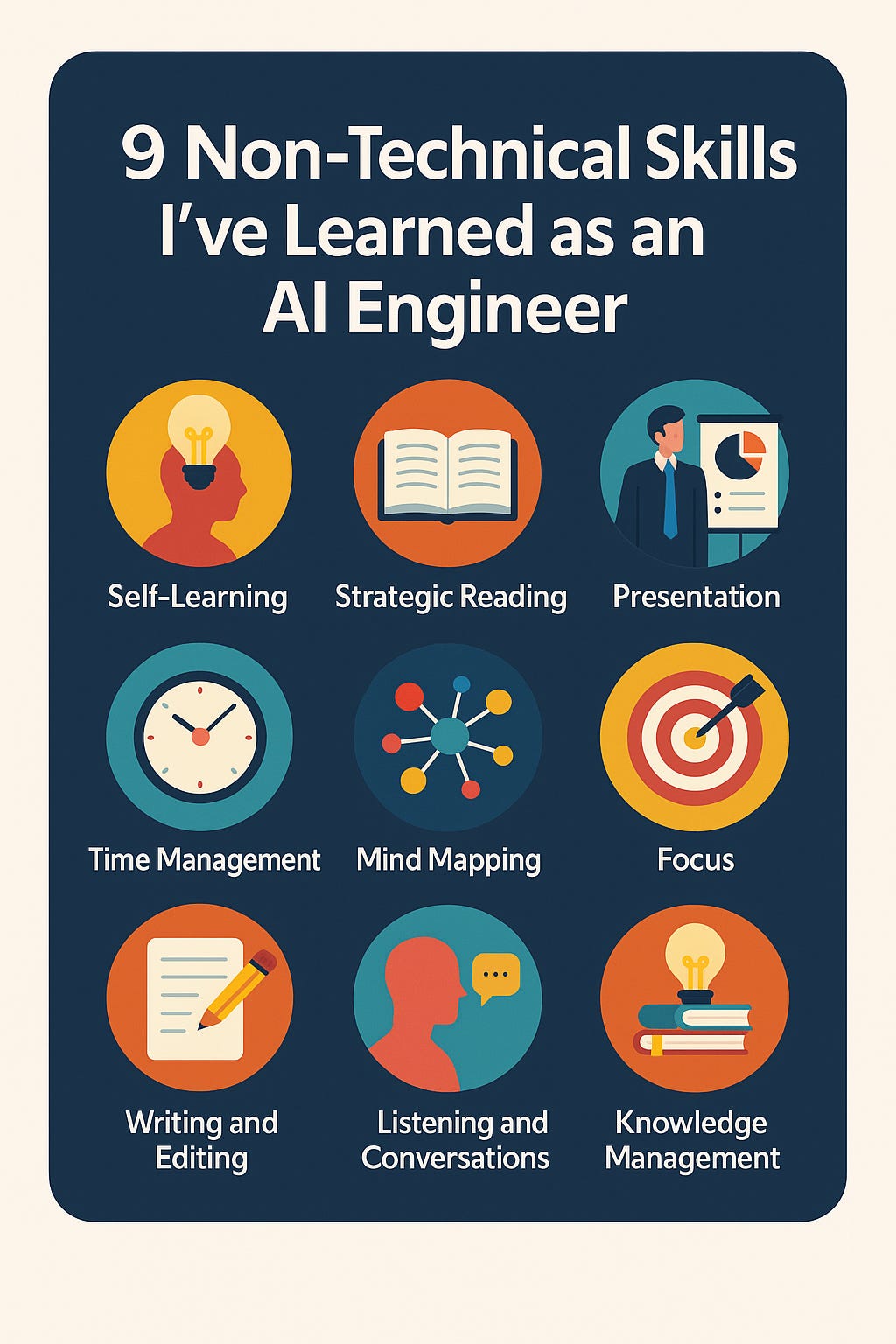
Here are nine that stand out to me:
Focused Self-Learning – I no longer try to finish entire courses. Instead, I look at my current project and pick only the most relevant topics to learn. It’s more like targeted problem-solving than open-ended studying. I think of it like shopping for ingredients when I already know what dish I’m going to cook.
Strategic Reading – Before diving into a book or paper, I skim to get a sense of structure—table of contents, summary, section headings. Then I decide which parts are worth going deep into. One book that really helped me build this habit is How to Read a Book by Mortimer Adler.
Writing & Editing – My writing process usually involves two passes. The first one is messy and unfiltered—just to get ideas out. The second pass is where I clean it up, clarify my thinking, and tighten the language. Reading it out loud helps me catch rough spots I wouldn’t otherwise notice.
Listening & Conversations – I used to talk too much in meetings. Over the years, I’ve gotten better at pausing and actually listening. Now I make a conscious effort to ask questions, paraphrase what I’ve heard, and make sure I’ve really understood the other person.
Presentation & Public Speaking – Whether it’s sharing a new feature or presenting a research idea, I follow a structure that works well: start with a problem, walk through a practical solution, and then discuss the benefits. I also prepare by talking through my slides out loud—usually while walking. I don’t use a script; I just try to get comfortable with the flow and message.
Low-Tech Thinking – When I’m planning or designing something, I start with paper. I sketch out diagrams, flows, or maps of ideas. Mind mapping is especially helpful for breaking down complex problems and exploring options.
Time Management & Prioritization – I block time on my calendar for deep work—coding, writing, or thinking. I do weekly and daily planning, and try to pick just one or two important things to focus on each day. It’s a simple habit, but it keeps me on track.
Deep Focus & Emotional Self-Awareness – I use the Pomodoro technique to work in short, focused bursts with breaks in between. I also keep a notebook nearby to jot down thoughts when I feel stuck or overwhelmed. Writing things down often helps me reset and figure out what’s really bothering me emotionally or stealing my focus.
Knowledge Management – I rely on tools like Obsidian, Readwise, and Matter to capture ideas and resurface them later. I don’t always read things immediately when I find them. If I come across a good article or video, I save it in one of my read-later apps—Readwise for text-heavy blogs, Matter for PDFs and narrated reading. Later, when I have space to reflect, I come back to it. These tools are now core parts of my workflow.
That’s my list. Not definitive, not polished—just what’s actually helped.
What would you add to yours?